
Turning Point Release Status
Turning Point Community Release Center (Male) is listed in FDC’s directory at 400 SW 2nd Avenue in Pompano Beach. It is a contract community release center within Florida’s corrections network. The contract setting does not turn an FDC resident into a county jail detainee or a discharged person. FDC remains the correct public status and release-record system.
A placement at Turning Point is one step in a state custody history. The person may have arrived from another FDC institution and may later move, return to a more secure setting, or complete the state custody episode. Only the person-specific state record can settle that sequence. The final release should show an actual Release Date and a corresponding last Date Out-Custody, not just a current projected date.
Check Turning Point Discharge
Start with the FDC Corrections Offender Network. Its menu separates current prison population, inmate release information, supervised population, and absconder records. For a claimed completed exit from Turning Point, select Inmate Release Information Search. The DC number gives the best match. Name and alias queries remain useful when the number is unknown.
Confirm the record with date of birth, photograph, physical descriptors, offenses, sentence dates, and county of commitment. Broward as county of commitment links the sentence to the county; it does not prove that Turning Point was the only FDC placement. Next, read the status, Release Date, release type, and incarceration history together. A future Current Release Date is not proof that the person has left.
- Choose FDC’s inmate release search from the official menu.
- Enter the DC number or use an exact name and alias query.
- Match identity and Broward sentence details across the record.
- Verify that Release Date aligns with the final Date Out-Custody.
- Search the supervised population for any continuing state obligation.
Note: A contract center can report program operations, while FDC’s state record is the public source for the completed custody event.
Turning Point Record Timeline
A reliable Turning Point release check is a timeline, not a single search result. Start with the state admission. Add later institution and movement entries. Mark the community release center stage without calling it discharge. Then locate the final out-custody date and any supervision period that follows. Keeping each step distinct avoids a common error in Broward records.
| Stage | Record clue | Meaning |
|---|---|---|
| State admission | FDC incarceration history | Start of the state custody episode |
| Turning Point placement | Current location or movement data | Continuing community release custody |
| Projected exit | Current or tentative release date | Estimate that may change |
| Completed exit | Release Date plus Date Out-Custody | End of the documented prison custody episode |
| Post-custody period | Supervised Population Search | Active, past, or no displayed FDC supervision |
If fields conflict, save the exact public labels and retrieval date. Do not repair the record with home arithmetic. FDC classification, central records, and the sentencing court can review sentence credit or legal orders that may have changed the date.
Turning Point Supervision Records
Final release from physical custody may lead to state supervision. Open the FDC Supervised Population Information Search after confirming the out-custody event. Use the DC number when available. Read Current Community Supervision History before Prior Community Supervision History and note the type, begin date, termination date, assigned office, and status.
Active means the person is under current community supervision. Active Suspense can reflect temporary unavailability for direct contact while an officer monitors another event. Absconder is a wanted-status category tied to unknown whereabouts and a violation warrant. A person should not be called discharged from every duty while the state record remains active. Conversely, a past termination date is stronger evidence that the displayed supervision period ended.
- Community release center
- An FDC custody placement designed for a structured transition stage.
- Release Date
- The actual date reported for the completed state custody event.
- Date Out-Custody
- The movement-history date supporting departure from FDC custody.
- Termination date
- The reported end of a particular state supervision period.
Turning Point Release Records
Use the FDC Public Records Center when public fields are not enough. State the full name, DC number, Turning Point Community Release Center, and the date range. Ask for a specific release or discharge history, admission and out-custody movement record, or release-date calculation history. Focused wording helps the custodian identify records and prepare any estimate.
FDC lists public-record assistance at (850) 717-9774. Release information is available at (850) 488-9167 and dc.release@fdc.myflorida.com. Classification or current-data questions use (850) 488-9859. Privacy, corrections confidentiality, and other lawful limits can require redactions. A request for the state movement history should not be sent to BSO merely because Turning Point is in Broward County.
400 SW 2nd Avenue
Pompano Beach, FL
(954) 942-7742
Contract community release center in FDC’s directory
The center’s number can route an operational question. The lasting release or discharge record comes from FDC. If the state sentence began with a county transfer, the Broward released-inmate records route can document that earlier BSO event.
Turning Point Custody Boundaries
Broward County has several custody systems, and each has a narrow role. BSO runs the county jail release log. FDC reports state imprisonment, community release custody, final release, and state supervision. BOP covers federal prison custody. ICE covers immigration detention. Turning Point belongs in the FDC column even though it is local and contract operated.
This matters when a name vanishes from one database. Absence from BSO current search after a transfer may simply mean state custody began. Absence from an FDC current-population search may lead to the release or supervision database. A release result then needs a check for ongoing supervision. The search sequence should follow the custody chain rather than repeatedly checking a roster that no longer owns the record.
| Question | Correct Broward-connected source |
|---|---|
| Did county jail custody end? | BSO release log and release reason |
| Is Turning Point placement current? | FDC inmate population or status detail |
| Was final state custody completed? | FDC Release Date and Date Out-Custody |
| Does state supervision remain? | FDC Supervised Population Search |
Turning Point Contract Context
The contract designation identifies how the center operates within FDC’s directory. It does not change which public record proves custody or discharge. Turning Point residents are part of the state corrections population during placement. Their DC number, FDC status, incarceration history, and release fields remain the core checks.
A center telephone call may help route a timely operational question, but a person-specific final record belongs with FDC. Ask the central record custodian for the state history when the public detail is unclear. This is especially useful when a recent movement has not yet appeared or when the same person has several custody episodes. Give the exact date range and identify Turning Point in the request.
The program name can also cause a wording error. “Community release” is the facility category, not proof that the man has been discharged. Use “placed at Turning Point” for the custody stage. Reserve “released from FDC custody” for a state record with the actual Release Date and matching last Date Out-Custody.
Turning Point Date Review
Future FDC dates can change. Gain-time awards, forfeitures, legal credit, discipline, sentence structure, court orders, and review all can affect a projected date. A current detail may warn that the date is subject to change or state that it is still to be set. Those labels should remain intact.
When the public date conflicts with a judgment or prior screen, save the current detail and ask FDC classification or release-data staff to review the field. Do not subtract gain-time or apply the eighty-five-percent rule on your own. The binding computation depends on the sentence and offense facts. An actual release row later becomes the key record for the completed episode.
Turning Point Search Fallbacks
Public search downtime or a recent update does not change the custody facts. Keep the DC number, date range, and center name ready. Release-data staff can address the release field, classification can address current sentence data, and the Public Records Center can produce a responsive movement or discharge record after review.
Use the center telephone for facility routing, not as a substitute for the official state history. If a prior BSO transfer is relevant, obtain that county record separately. Matching the BSO exit to the FDC admission can show how custody changed hands. The later Turning Point placement and final FDC out-custody event remain state records.
Turning Point Directory Entry
The official FDC facility directory identifies Turning Point as a male contract community release center and provides the Pompano Beach contact.
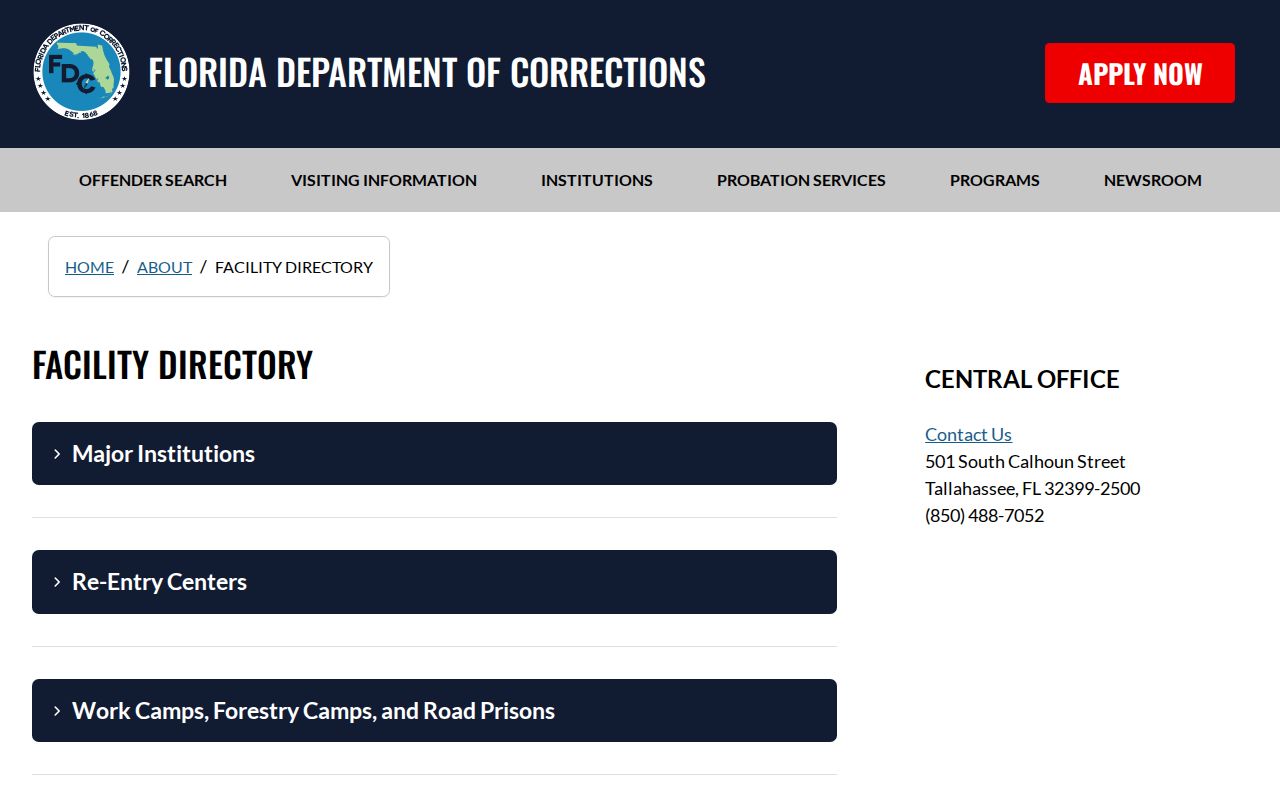
The directory confirms facility type and operator context. It does not establish that a named resident has reached final discharge.
The FDC release search provides the person-specific state route.
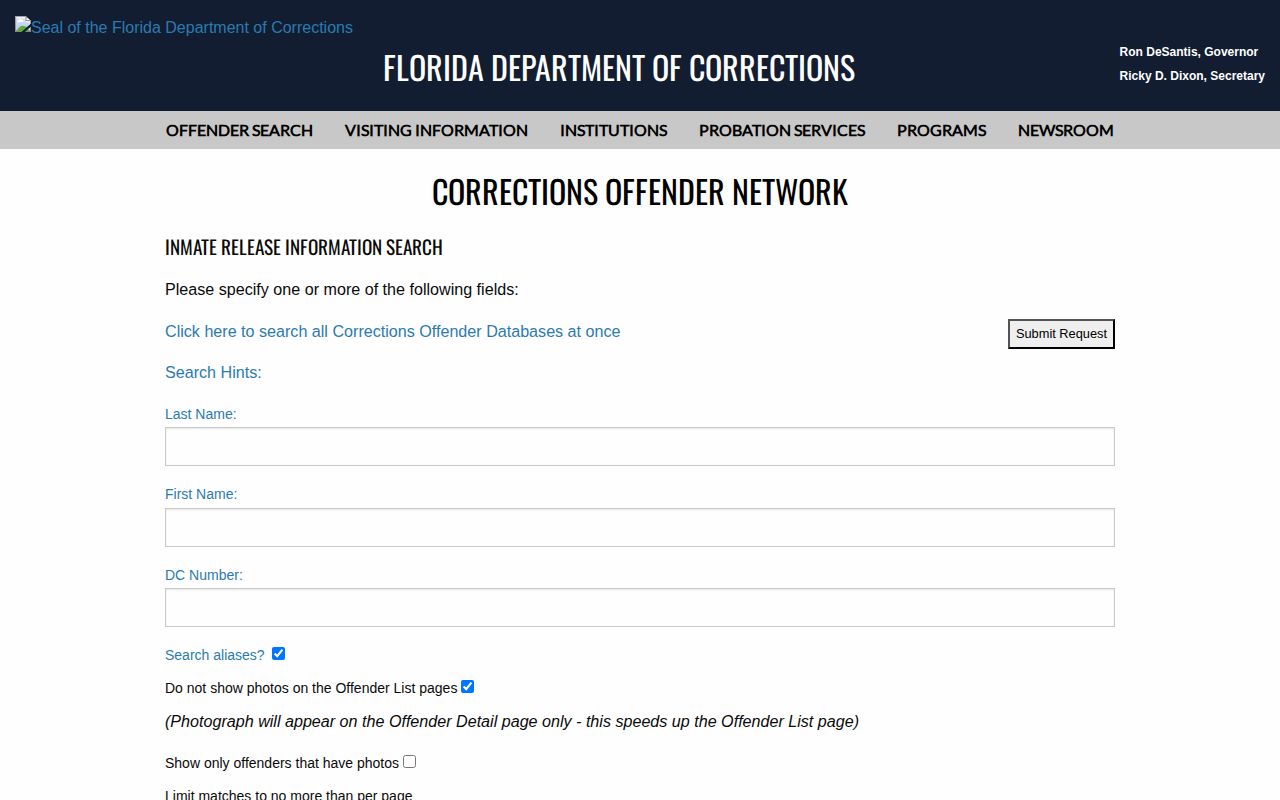
Match the DC number, then read the actual release and movement fields before checking supervision.