
Broward County 24-Hour Release Source
The official starting point is the BSO Inmate Release Log. It asks for one calendar date. It does not offer a control called "last 24 hours." To build a true same-day interval, open today's date and the prior date, then keep only entries whose Released time falls inside the desired start and end. That distinction matters at midnight and whenever the check occurs partway through a day.
BSO calls the information subject to change and periodically updated. It does not promise a minute-by-minute refresh or a set online retention period. A new court order still has to pass through jail processing before an exit is complete and posted. The current-custody Arrest Search may change on a different cycle. Neither an absent roster result nor a missing daily-log entry alone proves what happened.
The official release-log screen shows how Broward County jail releases are selected by date.
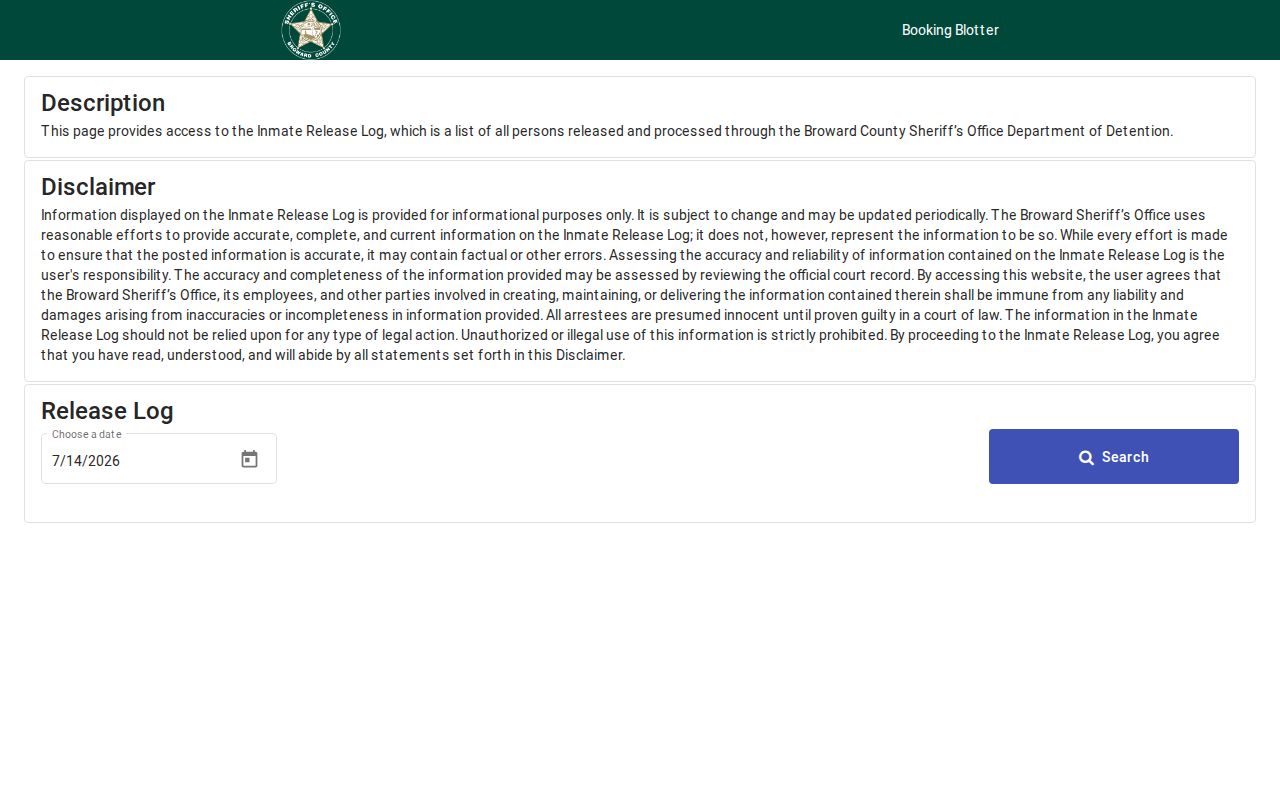
The date control is why adjoining calendar pages are needed for a rolling 24-hour check.
Check Broward County 24-Hour Releases
Start with a clear cutoff time. A search at midafternoon should look back to the same time on the day before, not treat both full date pages as the answer. Use the JMS number and birth date to separate similar names. Then read the coded reason before deciding whether the person left custody for the community or another agency.
- Open the BSO Inmate Release Log and select the current calendar date.
- Open the preceding date and note each exact Released timestamp.
- Keep only events within the chosen 24-hour span.
- Match the name with JMS number, birth date, admission date, arrest agency, and case or warrant data.
- Read Release Reason as BSO displays it. Follow a transfer into the receiving system.
- Use the Broward County released inmate search when the task is to confirm one named person rather than review the full same-day feed.
Observed reasons include surety bond, pretrial release with bond or electronic monitoring, and transfer to another jurisdiction. The first two describe an exit from physical jail custody with an active case or conditions possible. The transfer label means custody changed hands. It must not be shortened to "free" or treated as a community release.
Note: The separate BSO Booking Blotter lists arrests processed and may lag, so it is not proof of a completed release.
Broward County Release List Fields
Broward's daily record is more detailed than a simple name list. The live response carries identity, custody timing, agency, and charge data. Those fields allow a release event to be tied to the correct booking and later court record. The formatted card does not show a booking photo, and the structured response inspected for this research had no photo field.
| Field | What it shows |
|---|---|
| Name, birth data, JMS and BCCN | Identity details used to distinguish people and booking episodes. |
| Admitted and arrested times | When the Broward custody episode and arrest processing began. |
| Released date and time | The completed BSO exit timestamp used for the 24-hour cutoff. |
| Release Reason | BSO's coded explanation, including bond, pretrial release, or transfer. |
| Agency and officer | The arresting agency and officer data, which may differ from the jail operator. |
| Charge and case data | Description, statute, bond, sealed flag, and warrant or case number when present. |
The approved BSO release result demonstrates the field arrangement without turning a transient result into a lasting claim about any person.
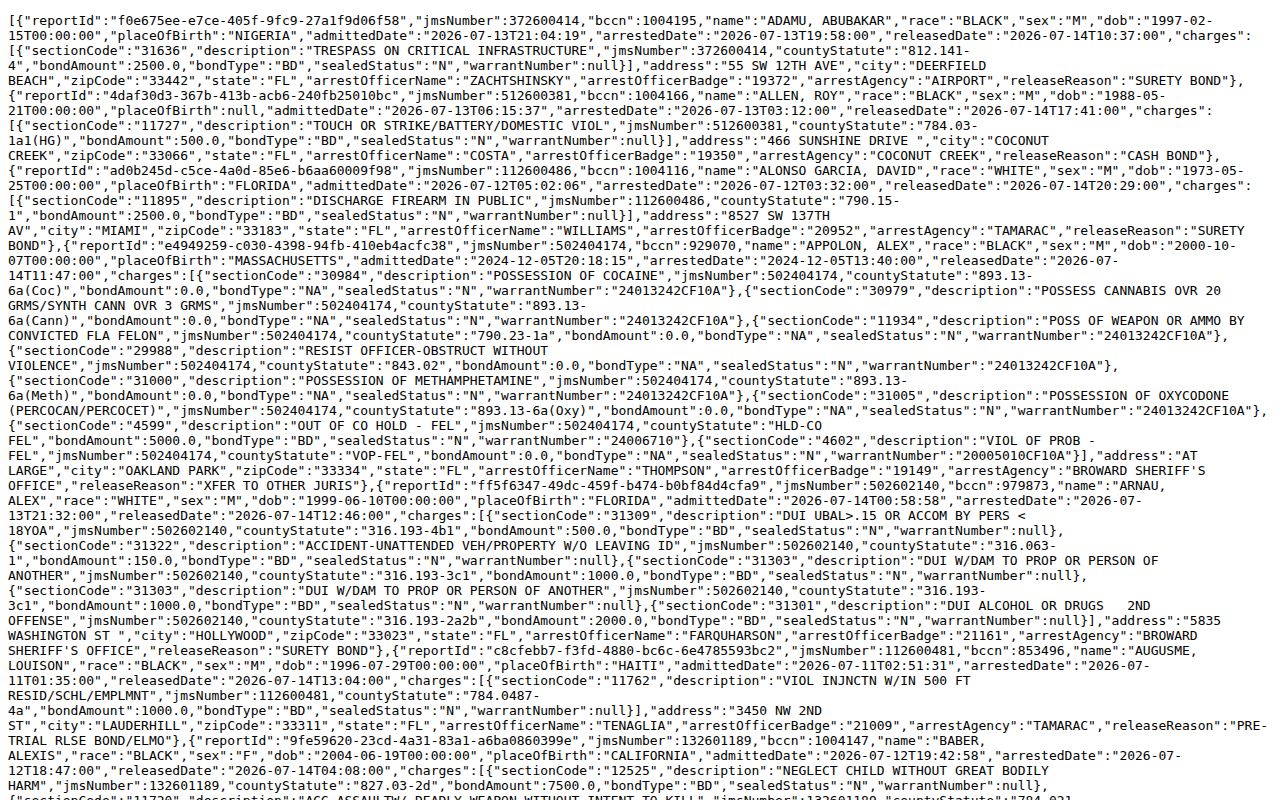
Match several fields together. A shared name or similar charge is not enough to establish identity.
Where Broward County Releases Process
Every entry into and release from BSO's four-jail system is processed through Main Jail Central Intake. This applies even when the person was held at Joseph V. Conte Facility, North Broward Bureau, or Paul Rein Detention Facility. The daily log is therefore systemwide. A detention location does not create a separate release list or prove that someone walked out from that facility.
Eligible release processing has no fixed gate time. BSO explains that timing can vary with simultaneous intake volume and the availability of state and national database information. Staff must also account for holds and legal authority before custody ends. A signed order can precede the public Released timestamp, while a person shown at another BSO detention unit still exits through the central process.
The BSO Department of Detention description identifies Central Intake as the systemwide entry and release hub.
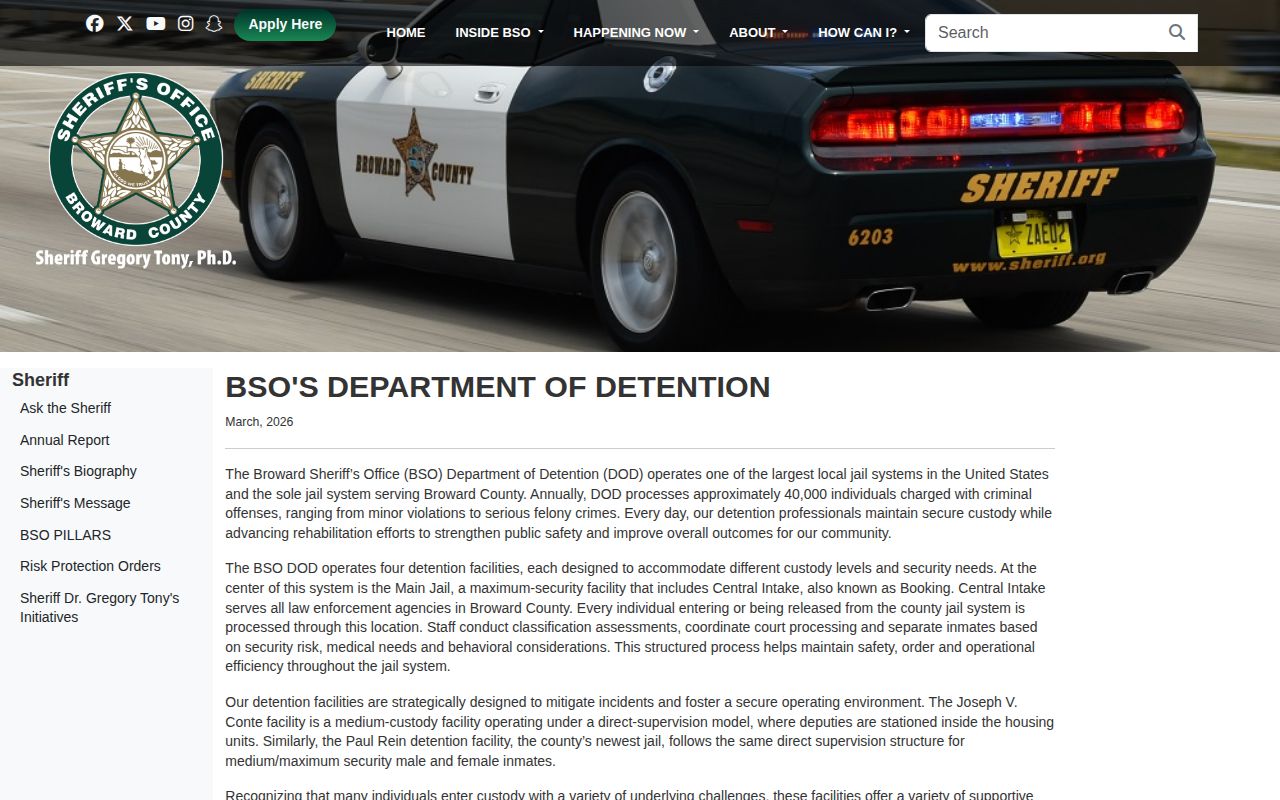
That central route explains why one daily product covers releases from all four county detention facilities.
Broward Release Feed Date Quirk
Broward's product is a one-date selector with exact times, not an official rolling 24-hour list. Its older branded release-log host was returning an error during the research check, while the current BSO booking-data application and live data route still exposed the product. Use the working application route. A saved legacy bookmark should not be taken as proof that the underlying release records disappeared.
The same quirk affects wider checks. A reader seeking the Broward Jail Releases: 72 Hours must combine several dates, not click a separate three-day control. Preserve each timestamp before merging the results. This avoids double counting and keeps a release just outside the chosen interval from being presented as recent.
When an older date fails, request the booking and release sheet from BSO Public Records. Give the name, birth date if known, JMS or arrest number, likely booking and release dates, and requested document. The Broward Clerk docket is the next source for the court action. It explains the case but does not replace the jail's custody timestamp.
BSO offers online public-record instructions and a request portal. A focused request is easier to route than a broad demand for every record. Ask for the release sheet or booking-and-release record tied to one custody episode. State the approximate dates and identifiers. If the question concerns why a judge acted, request the docket entry or certified order from the Clerk instead of asking BSO to interpret the court's decision.
Phone and online checks serve different roles. The detention information desk can address a current location question, while a written request creates a traceable path to an enduring document. VINELink is useful before an expected change because it can send an alert. FDC's release search applies only when the person had a state-prison episode. A Broward bond release should not be expected to appear there merely because it occurred in Florida.
Note: Online visibility has no published retention guarantee, while the agency may still hold a responsive public record outside the web display.
Broward County Release Versus Custody
A completed BSO Released timestamp proves an exit from that county custody episode. It does not always mean return to the community. Surety bond and court-ordered pretrial release end physical BSO confinement while a criminal case and conditions may continue. Time served can close one sentence without resolving every case or hold. "XFER TO OTHER JURIS" points to another custodian.
| Result | Next check |
|---|---|
| Current BSO location | The person remains in BSO custody; record the JMS number and facility. |
| Bond or pretrial release | Read the Broward Clerk docket for conditions and later disposition. |
| Transfer to state custody | Use the FDC inmate-population search, not the FDC historical release search. |
| Federal or immigration transfer | Follow the BOP, federal court, U.S. Marshals, or ICE route indicated by the record. |
If the daily entry is missing but the current roster no longer has the person, wait for normal processing and check adjoining dates. For urgent status information, the BSO detention information desk is (954) 831-5900. For lasting proof, use a BSO records request and obtain a certified court record when the legal outcome matters.
Keep the event date separate from the case result date. The jail timestamp records when BSO custody ended. A later docket entry can address a charge, bond, sentence, or dismissal. Reading both dates in order prevents a later court action from being mistaken for the moment the jail doors opened.