
Broward Parole and Probation
Probation is imposed by a court instead of, or after, a custody term. Parole is a discretionary early release available only to Florida prisoners who meet narrow historical eligibility rules. Florida ended ordinary parole eligibility for most crimes committed on or after October 1, 1983. Conditional release is different again: FCOR describes it as mandatory post-prison supervision for people who meet statutory criteria. The label on the record matters because each status begins, changes, and ends under a different legal authority.
| Status | Who orders it | Broward verification path |
|---|---|---|
| Felony probation or community control | State court | FDC Supervised Population Search and court order |
| Misdemeanor probation | County court | Broward Clerk docket and county program record |
| Parole | Florida Commission on Offender Review | FDC supervision record plus FCOR written action |
| Conditional release | FCOR under statute | FDC status, FCOR conditions, and discharge record |
| Federal supervised release | U.S. District Court | Federal docket and U.S. Probation |
- Parole
- Eligible early release with the rest of a prison term served under Commission conditions.
- Probation
- Court-ordered community supervision.
- Community control
- A restrictive form of community supervision administered by FDC.
- Discharge
- The recorded end of the supervision obligation.
Residence in Broward does not select the supervisor. FDC Community Corrections handles state felony cases and post-prison supervision. BSO Community Programs includes county-level misdemeanor probation functions. U.S. Probation and Pretrial Services handles federal cases. The sentencing order and current record are controlling.
Verify Broward Post-Release Supervision
For a state felony record, use the FDC Supervised Population Information Search. A DC number gives the cleanest match. A name search must be checked against birth date, photograph, offenses, county, and other identity fields. Read Current Community Supervision History before Prior Community Supervision History. A historical entry may remain visible after discharge.
- Identify whether the case is state felony, county misdemeanor, FCOR release, or federal supervision.
- Search the matching agency record with the DC number or exact name and identity details.
- Read the supervision type, current status, begin date, termination date, and assigned office.
- Open the court docket or FCOR record to verify the order and any later modification, violation, or discharge.
- Contact only the office shown on the current record. Ask for public confirmation without seeking protected case details.
The FDC search does not contain people sentenced only to county jail, county probation, or another non-FDC program. For those cases, use the Broward Clerk case search and obtain the controlling court order. Federal supervised release belongs to the federal docket and U.S. Probation at 299 East Broward Boulevard in Fort Lauderdale.
The FDC supervision form shows the public entry fields and separates current from prior history.
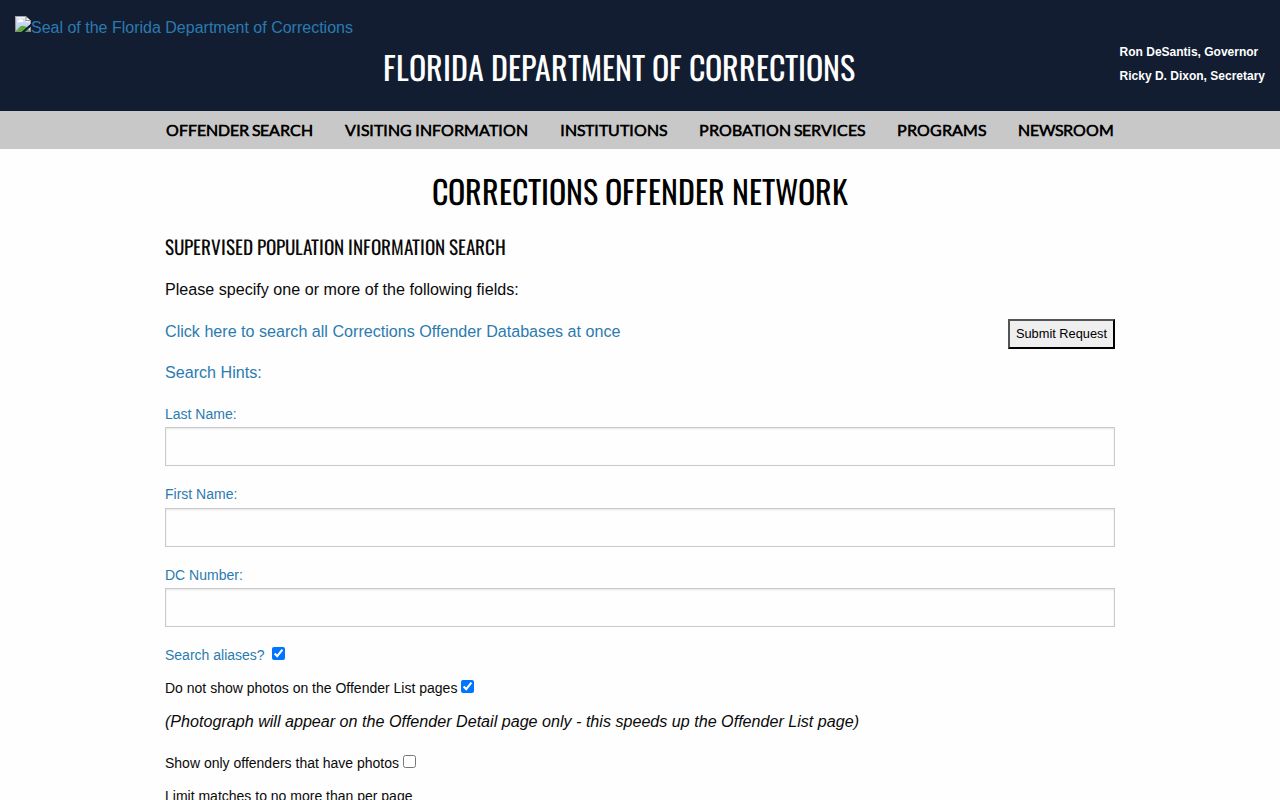
A matched result should be compared with the release record because out of prison and off supervision are not the same status.
Broward Circuit 17 Supervision
FDC's Fort Lauderdale Circuit Office says Circuit 17 covers all Broward County. It supervises court-ordered probation and community control plus people released from prison with post-release supervision. The administration office is a routing point, not proof of a person's assignment. The online record or officer instruction identifies the office that should receive a person-specific inquiry.
5100 NW 33rd Avenue, Suite 165
Fort Lauderdale, FL 33309
(954) 677-5913
ftlauderdale.cir@fdc.myflorida.com
FDC also lists Broward Central, Intake, North, South, East, West, Cypress, and Hollywood offices. Several share a street address but have different phone numbers and functions. Calling the nearest building can misroute the question. Use the assigned office from the FDC result and confirm reporting instructions with the officer.
As of February 13, 2026, the Circuit 17 page reported 13,505 people under supervision. That is a circuit population figure, not a count of parolees and not a measure of people released from the Broward jail.
Broward Absconder Status Check
FDC uses distinct status terms. “Active” means active community supervision. “Active Suspense” means the person is temporarily unavailable for direct supervision, such as while held in jail or another facility, while the officer continues monitoring events. “Absconder” means FDC reports that the person's whereabouts are unknown or unavailable for supervision and that a violation warrant has issued. None of these labels should be replaced with a guess based on a missed appointment or a blank search.
The FDC Absconder/Fugitive Information Search is the correct public route for that state status. Confirm the DC number, photograph, birth date, offense, and county. The public should not attempt to locate or confront anyone. FDC lists its Absconder Unit at (850) 717-3475 on weekdays from 8 a.m. to 5 p.m.; urgent safety matters belong with law enforcement.
Supervision conditions come from the court or Commission order. They may concern reporting, travel, treatment, payment, residence, monitoring, or other case-specific duties. A violation allegation does not by itself prove revocation. The docket or FCOR written order shows what the deciding authority did, including modification, continued release, or return to custody.
Note: VINELink tracks custody events, not every probation condition or supervision-status change.
Broward Supervision Discharge Records
Completion should be confirmed from an affirmative record. For FDC supervision, look for a termination date and status in the current or prior community supervision history. For parole or conditional release, obtain the applicable Commission discharge or written action. For court-imposed probation, read the court order that ends, terminates, or otherwise disposes of supervision. A blank current search can reflect spelling, data timing, or a different agency and is weaker than a dated discharge record.
Florida Statutes section 947.24 addresses discharge from parole and release supervision. Section 947.1405 governs qualifying conditional-release cases. A person may have completed one term while another case, warrant, or federal obligation remains. Build the timeline by agency and case number, and keep the prison release date separate from the supervision termination date.
For certified proof, request the court order from the Broward Clerk or an FCOR written action from the Commission Clerk. The Broward County release-record search connects those supervision records to the earlier jail or prison exit.
Find a Broward Supervision Office
Circuit 17's unusually detailed office network includes Intake plus Central, North, South, East, West, Cypress, and Hollywood. Geographic names are not safe assignment rules. The supervision record's listed office controls where to call and report. Broward East and West, for example, share the same street location but use separate phone lines. Intake has a distinct office in Lauderdale Lakes, while circuit administration is in Fort Lauderdale.
Use the assigned office to resolve reporting instructions, not to seek protected personal details. General state Community Corrections information is available at (850) 717-3444 and co-supervision@fdc.myflorida.com. A location change should be confirmed through the officer or updated FDC record rather than inferred from an old directory entry.
The directory lists Broward Central and North at 5600 NW 9th Avenue in Fort Lauderdale, while Broward South, East, and West are listed at 2928 North State Road 7 in Lauderdale Lakes. Cypress is at 5610 NW 9th Avenue, and the office named Hollywood is at 3520 West Broward Boulevard. Shared sites make the phone number and assigned unit as important as the street address.
Broward Post-Release Reentry
BSO's Reentry Division operates a Broward Reentry Portal for people returning from Florida prisons and a voluntary Jail Reentry Desk at the Main Jail exit. The desk can assess immediate needs, provide referrals and bus passes, and follow up after discharge. These services can help a person meet practical needs after custody, including connecting with programs named by the agency.
Reentry help is not the same as parole or probation. Participation does not prove supervision, and the desk cannot replace the assigned officer, court order, or FCOR conditions. Use the service for support and the official agency record for legal status.
Broward Parole Hearing Records
FCOR publishes a live Commission Voting Schedule and a detailed agenda for dated sessions. Agenda fields can include the person's name, DC number, category, county, offense, case number, and panel or group. Categories extend beyond parole to revocation, conditional release, and conditional medical release. The schedule recurs often, but holidays and Commission business can change dates. Use the current calendar rather than relying on a fixed weekday.
An agenda is not the decision. No general public post-vote results search was verified. Obtain the written action from the Commission Clerk at (850) 488-1293 or through FCOR Public Records at fcorlegal@fcor.state.fl.us and (850) 848-4460. A Commission action may authorize a date, delay review, require a satisfactory release plan, change a presumptive date, or address revocation. Preserve the agency's exact wording.
FCOR accepts public-record requests without requiring a written submission or the requester's name. Chargeable copies may require an estimate and prepayment. Include the DC number, meeting date, and action sought so staff can distinguish the written order from the public agenda.
Eligibility is narrow. Florida Statutes section 947.16 applies offense-date and sentence-category rules, while section 947.1745 addresses final interviews near a presumptive release date. Appearance on a calendar does not guarantee release. Likewise, a person released from prison under conditional release should not be labeled a parolee unless the Commission record uses that status.