
FDC Miami Release Routes
Federal Detention Center Miami is part of the federal detention and prison system, not Broward Sheriff’s Office. It can serve defendants from Broward-origin federal cases in the Southern District of Florida. A person transferred from BSO to federal custody has left the county jail system, but that handoff is continued custody. The county release log cannot certify the later federal release.
The correct federal source depends on the stage. USMS manages many people in court-ordered federal pretrial custody and can house them in federal, local, state, or contract facilities. BOP manages sentenced federal custody and maintains a public locator with records from 1982 to the present. The federal court docket supplies detention and release orders. U.S. Probation can address permitted supervision information after release.
Confirm FDC Miami Release
Begin with the BOP Inmate Locator when the person entered BOP custody or may have a sentenced federal history. Search by BOP register number, DCDC number, FBI number, or INS number when available. The name route accepts first, middle, and last name plus optional race, age, and sex. Exact identifiers reduce false matches.
A BOP result can show name, register number, demographic information, release date, and location or status. “Released” supports a completed BOP custody event. “Not in BOP Custody” is broader. BOP warns that another corrections or law-enforcement agency may hold the person and that supervision may remain. Compare the result with the federal docket before deciding what the status means.
- Search the BOP locator by register or other federal identifier.
- If needed, use the name search and match demographic details.
- Record the release date and exact location or status wording.
- Open the federal court case for detention, release, and sentencing orders.
- Check U.S. Probation when the record indicates supervised release may continue.
Note: First Step Act calculations can affect displayed dates, so a changing projected field is not the same as an actual federal release.
FDC Miami Pretrial Records
The U.S. Marshals Service custody description explains that USMS responsibility can run from a federal court’s custody order through acquittal or conviction and delivery to BOP. A federal pretrial defendant may be housed at FDC Miami or another contract site. USMS does not offer a public person locator like BOP.
Use the federal docket for a magistrate judge’s detention or release order, later bond action, plea, judgment, and sentence. A court release order documents judicial action, while the custodian’s record documents the physical custody event. The dates can differ due to processing, another hold, or transfer. A BOP no-result is not conclusive for a person held only in a pretrial USMS arrangement.
| Federal stage | Primary source | What it answers |
|---|---|---|
| Pretrial detention | Federal court docket and USMS records | Custody order and pretrial handling |
| Sentenced imprisonment | BOP locator | Federal prison status and public date |
| Completed BOP release | BOP released result | End of the displayed BOP custody event |
| Post-release supervision | Federal judgment and U.S. Probation | Supervised-release term and local office |
FDC Miami Court Timeline
The federal docket provides the legal spine for an FDC Miami custody check. A detention order explains why pretrial custody was authorized. A later release order, plea, judgment, or sentence changes the legal stage. The physical movement record may follow after the order, particularly when transport or another hold must be resolved. Keep the court date and custody date as separate facts.
If conviction leads to a BOP sentence, the register number links the later prison history. A person can move away from Miami while remaining in BOP custody, and the nationwide locator follows that federal record. When BOP later reports Released, compare the date with the judgment and any supervision term. The Southern District origin does not mean the person was released in Broward County.
For a pretrial case that never became BOP custody, the BOP locator may have no useful result. Use the docket and a focused USMS record request instead. State the federal case number, known detention period, and record sought. This route respects the difference between a court decision and the agency’s physical custody record.
FDC Miami Status Labels
Federal records answer narrow questions. A BOP release date does not prove that every case, warrant, immigration issue, or supervision term ended. Likewise, “Not in BOP custody” does not establish residence in Broward County. Another sovereign may have custody, or the person may be in a pretrial setting not exposed by the locator.
Create a timeline when the case crossed systems. A BSO release reason may record a transfer. The federal docket can show the federal custody order. USMS records cover pretrial handling, and BOP history covers sentenced imprisonment. The BOP release result comes later if a prison sentence was served. Each agency label should remain attached to its source.
- Pretrial detention
- Federal custody before final disposition, often managed by USMS under a court order.
- Released
- A BOP status reporting that the displayed federal prison custody event ended.
- Not in BOP custody
- A broad locator status that does not rule out another custodian.
- Supervised release
- A court-ordered period administered after federal imprisonment by U.S. Probation.
FDC Miami Release Records
Federal records are divided by custodian. Ask the court for judicial orders. Ask USMS for an existing pretrial detention or movement record within its control. Ask BOP for a federal prison record. Ask the supervising agency only for information it may lawfully provide. No single request to FDC Miami automatically gathers the entire case and custody history.
A specific USMS record can be sought through USMS FOIA. Include the person’s name and known identifier, date range, exact record, and preferred format. Privacy Act and law-enforcement redactions may apply. For a BOP history, use the BOP locator first and then the responsible BOP records channel if the public result is incomplete.
Federal detention serving the Southern District of Florida
Includes Broward-origin federal cases
BOP public route: Inmate Locator
Pretrial records: Federal court and USMS
For local federal supervision, research identifies U.S. Probation at 299 East Broward Boulevard, Fort Lauderdale, (954) 769-5500. The Broward County release records search applies only to a separate BSO custody episode before the federal handoff.
FDC Miami Release Boundaries
BOP, USMS, FDC, ICE, and BSO are different systems. FDC in this facility name means Federal Detention Center, not Florida Department of Corrections. That acronym overlap can send a search to the wrong database. Florida’s DC number and state release detail are not federal BOP records. BOP uses a federal register number and nationwide locator.
ICE also has a separate locator. A federal criminal case and an immigration detention event can follow one another, but neither system’s absence proves the other status. If a federal docket shows a release order yet the person does not appear in the community, check the custody chain for another hold or receiving agency. Do not infer the destination from a single database.
| System | Identifier or source | Use |
|---|---|---|
| Broward Sheriff’s Office | JMS number and BSO log | County jail exit or transfer |
| U.S. Marshals Service | Federal case and agency records | Federal pretrial custody |
| Bureau of Prisons | Register number and BOP locator | Sentenced custody and release result |
| Florida Department of Corrections | DC number | State prison custody, not FDC Miami |
| ICE | A-number and ODLS | Immigration detention or recent release |
FDC Miami Supervision Records
A federal prison release can begin a court-ordered term of supervised release. The judgment states the term and conditions, while U.S. Probation administers the supervision. The BOP locator does not certify that supervision ended. Its role is limited to the federal prison custody status and date it displays.
For a Broward-connected person, the Fort Lauderdale U.S. Probation office is a local contact point, but the assigned office may depend on the court and approved residence. Use the judgment and permitted agency confirmation. Completion should be grounded in the court or supervising record, not in silence from BOP. A new detention event also needs its own source.
This last check turns a release date into a fuller federal timeline: BSO transfer if one occurred, federal court detention, USMS handling, BOP sentence and release, then supervised release. Each event can be true at once because each describes a different stage.
FDC Miami Locator View
The official BOP Inmate Locator shows the identifier and name fields used for a Broward-origin federal release search.
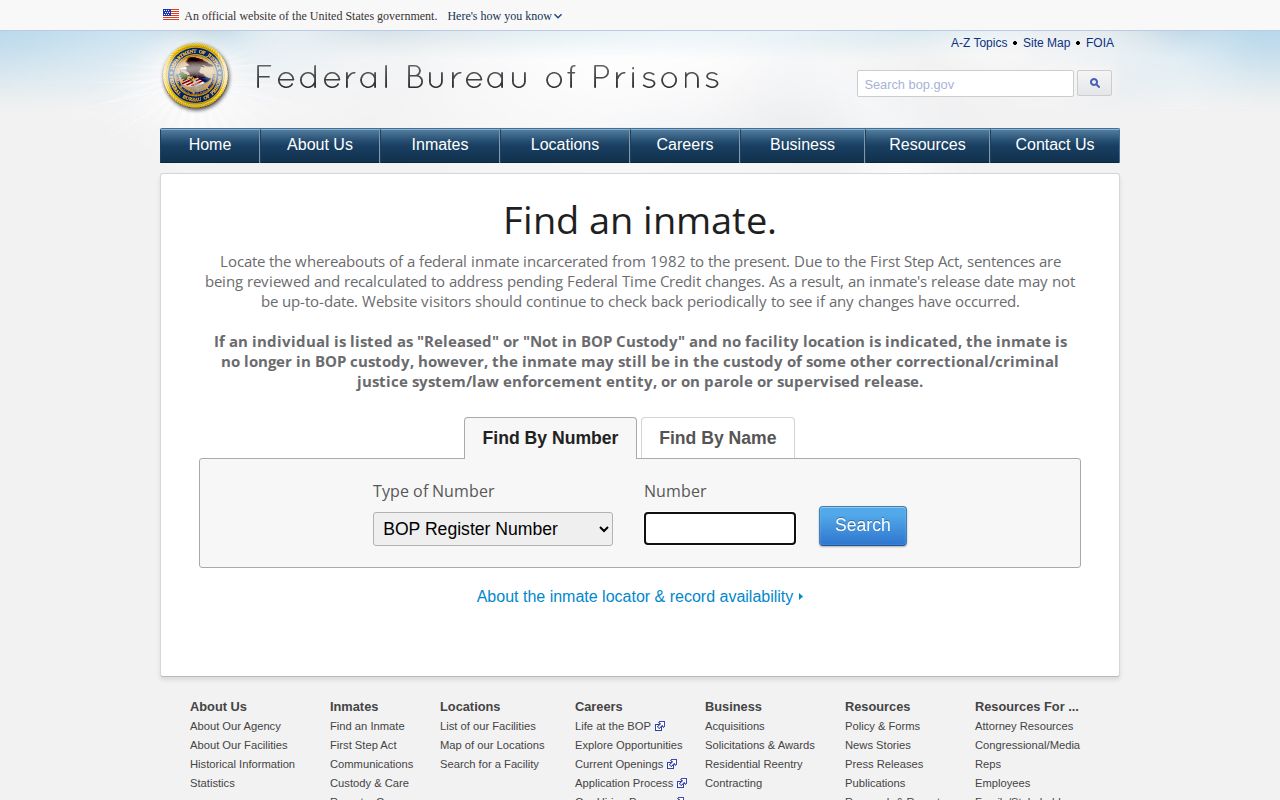
The captured locator supports the federal search route. The result still must be read with the court case and any USMS or supervision record.
A direct facility search is only one part of the inquiry. BOP’s nationwide record can follow a person after transfer away from Miami, while the court docket remains the source for detention and release orders tied to the Southern District case.