
Broward Projected Versus Actual Release
A projected date is a forward-looking calculation. It may be called scheduled, tentative, expected, or current depending on the agency and record type. An actual release date is retrospective. It records a completed custody event. Those labels cannot be swapped. A person can have a visible future date while the same FDC record says “Currently Incarcerated,” which means state custody continues.
For a completed state-prison event, FDC’s released record uses “Release Date,” and the incarceration history can show a matching Date Out-Custody. For a completed Broward jail event, the BSO date log gives the released timestamp and release reason. The court docket may explain the order but is not the physical exit record. A bond order can precede processing, while a transfer can end BSO custody without returning the person to the community.
Pretrial detention is different. A person awaiting a Broward case may have an expected field in Arrest Search, but no binding sentence-based date exists. Bond payment, a judge’s order, an unresolved hold, dismissal, remand, or a new warrant can change the custody path.
Find Broward Projected Release Dates
Start by identifying the custodian. Main Jail, Conte, North Broward, and Paul Rein belong to BSO. A state prison belongs to the Florida Department of Corrections even when Broward is the county of commitment. Federal and immigration cases use different systems. Searching the wrong database is the most common source of a misleading date.
- Check the current BSO Arrest Search for a county detainee or the FDC inmate-population search for a state prisoner.
- Match an exact JMS, arrest, DC, or case number. Confirm the name, birth date, offenses, and county or case data.
- Read the label literally. Record “Expected Release Date,” “Current Release Date,” “Tentative Release Date,” “TO BE SET,” or “Release Date” exactly as shown.
- Check the current custody line. A state result that says currently incarcerated is still a projection.
- Compare the judgment and sentence, credited time, holds, and later court orders when the public date is disputed.
- After the event, confirm the actual BSO released timestamp or the FDC Release Date and Date Out-Custody.
The Broward County released-inmate search supplies the full confirmation path after the projected date passes. A missed estimate does not establish misconduct or an error. The agency may have recalculated credit, applied a hold, received a new order, or not yet completed release processing.
FDC Current Release Date
The FDC Inmate Population Information Search covers people in the state-prison population. A current detail can display “Current Release Date.” FDC warns that the value is subject to change because of gain-time awards, gain-time forfeitures, or review. “TO BE SET” means the date awaits review. Neither label is an actual release record.
FDC’s statute uses the formal term “tentative release date.” The public web label and the statutory term describe the projection from different angles. Preserve the screen label in notes, then explain its role. Do not rename it a guaranteed date. State prisoners can also have a maximum sentence expiration date, mandatory minimum, conditional-release issue, or older parole framework that affects what the public field means.
The mapped FDC future-date example shows the current projected label and warning.
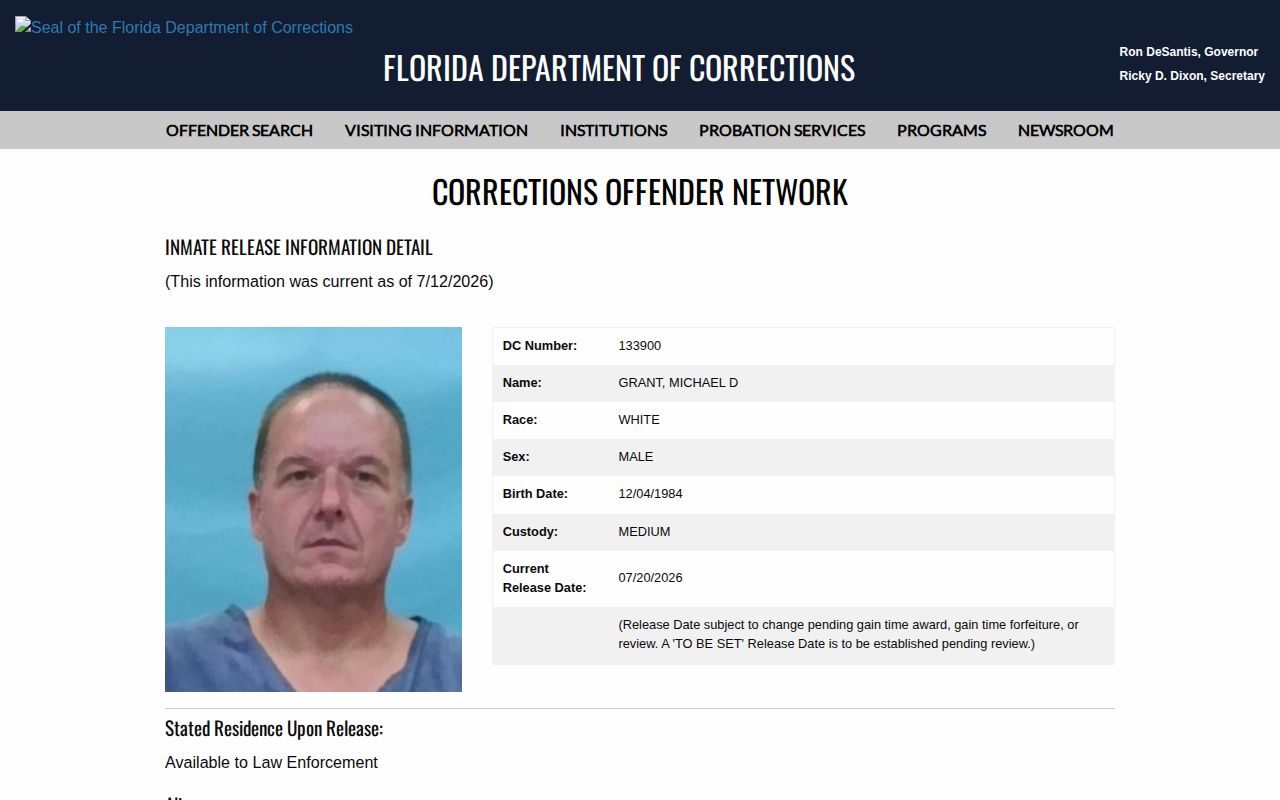
The image demonstrates why the custody status and warning must be read with the date instead of treating the field as a completed discharge.
Broward Actual Release Proof
An already released FDC record has a different structure. It shows “Release Date,” and the final incarceration-history row can show the same Date Out-Custody. That pairing documents a completed state-prison episode. It still does not prove that all supervision ended, that no new case exists, or that another authority did not take custody. Check the supervised-population record when post-prison control may continue.
A BSO county-jail exit will not normally appear as an FDC prison release unless the person also has a state-prison history. For BSO, use the Inmate Release Log. It records the exact released time and reason. Bond, pretrial release, and time served can be community-directed. “XFER TO OTHER JURIS” is continued custody under another authority, not community release.
| Record label | System | Meaning |
|---|---|---|
| Current Release Date | FDC current detail | A changeable projection while state custody may continue |
| Tentative release date | Florida statutory framework | Maximum expiration adjusted by applicable gain-time |
| Release Date and Date Out-Custody | FDC released detail | A completed state custody event |
| Released timestamp and reason | BSO release log | The completed county-jail exit and agency-coded path |
Note: A court docket explains the legal order, but the jail or prison record supplies the agency’s actual out-custody event.
Florida Release Date Labels
Broward’s distinctive date problem is the overlap of two legal frameworks and several web labels. The FDC screen says “Current Release Date.” Florida Statute § 944.275 calls the gain-time projection a “tentative release date.” The public record can also say “TO BE SET,” which means review remains pending. A BSO current-custody result may display expected or projected fields that are not the systemwide released timestamp.
Each phrase should remain tied to its source. FDC’s current date is a state-prison calculation. BSO’s expected field is a county-jail estimate. FDC’s actual Release Date describes a completed state event. BSO’s released timestamp describes a completed county event. The date itself is not enough without the custody status and record category.
This separation also stops the state 85-percent framework from being copied onto every Broward jail sentence. County good conduct rests on a different statute and local implementation. A person seeking a binding calculation should contact FDC classification or the sentencing court rather than perform sentence arithmetic from a public screen.
FDC Gain-Time Release Calculation
Section 944.275 begins with a maximum sentence expiration date reduced by lawful credit. The tentative release date adjusts that maximum by gain-time that applies to the person and sentence. Awards or restored credit can move the date earlier. Forfeitures can move it later, but not beyond the maximum expiration. New sentences, jail credit, violation time, court orders, sentence structure, and agency review can also change the calculation.
Gain-time categories depend on offense dates and other facts. Basic gain-time of ten days per month applies to older offense windows, not automatically to every current prisoner. Incentive gain-time is discretionary, and its ceiling varies by offense date. For covered offenses on or after October 1, 1995, the general incentive ceiling is ten days per month. Meritorious and specified educational awards exist but are not automatic. Serious-offense limits and forfeiture rules must be read in the current law.
For covered post-October 1, 1995 sentences, gain-time generally cannot produce release before 85 percent of the imposed sentence is served. Time physically incarcerated can count toward that floor. The rule does not turn a life sentence into a numeric date, override a mandatory minimum, or supply a shortcut calculation for every record.
The official Florida gain-time statute is captured in the mapped image.
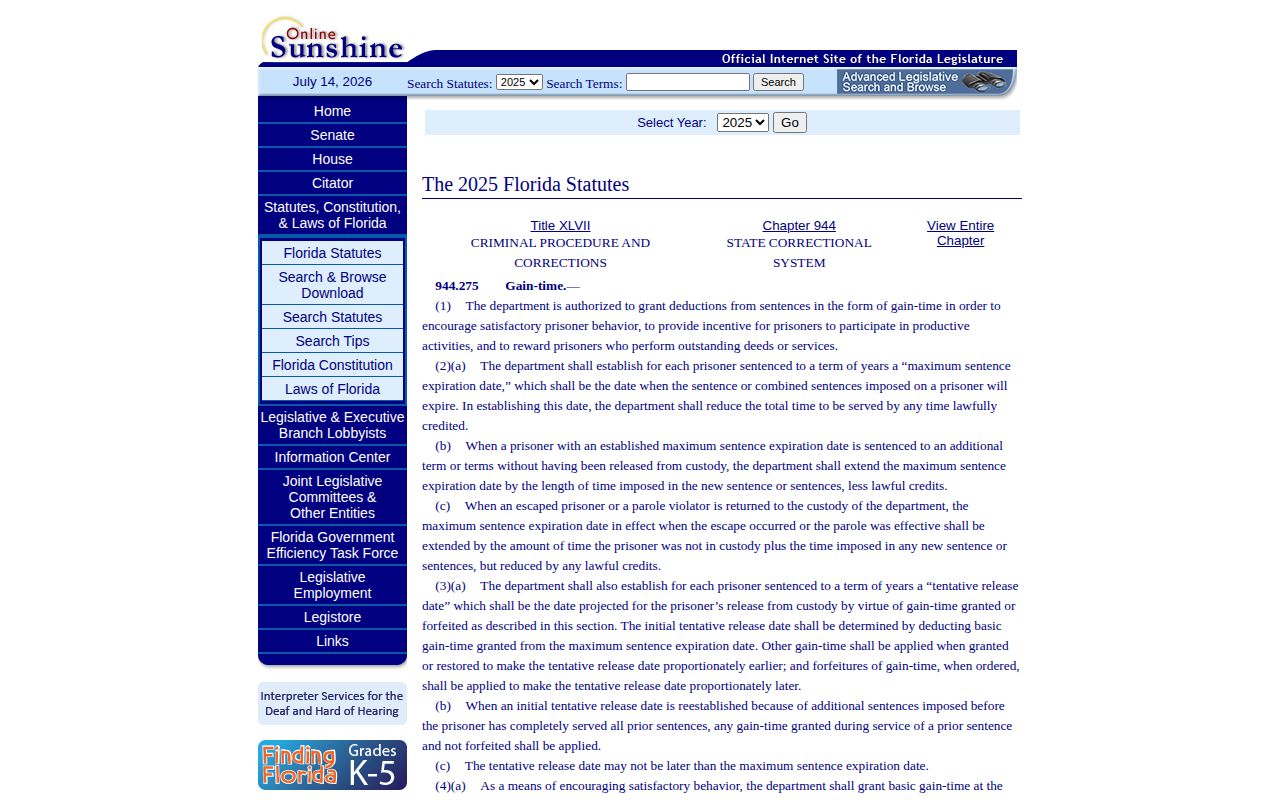
The statute supports the tentative-date framework while showing why offense dates, actual awards, and sentence limits matter.
Broward County Good Conduct
A BSO county-jail sentence follows a separate framework. Florida Statute § 951.21 addresses county-prisoner good conduct unless the county commission discontinues or revises it. The statutory ceilings are up to five days per month in years one and two, ten days per month in years three and four, and fifteen days per month in later years. Meritorious good time may add up to five days per month, while violations can cause forfeiture.
Those are statutory ceilings, not a promise that a named Broward detainee receives the maximum. Local policy, sentence details, conduct, credited time, holds, and court action matter. A pretrial detainee is not serving a fixed county sentence merely because time has passed in jail. The FDC 85-percent rule should not be applied mechanically to a BSO sentence.
The mapped county-prisoner statute source displays the distinct good-conduct provisions.
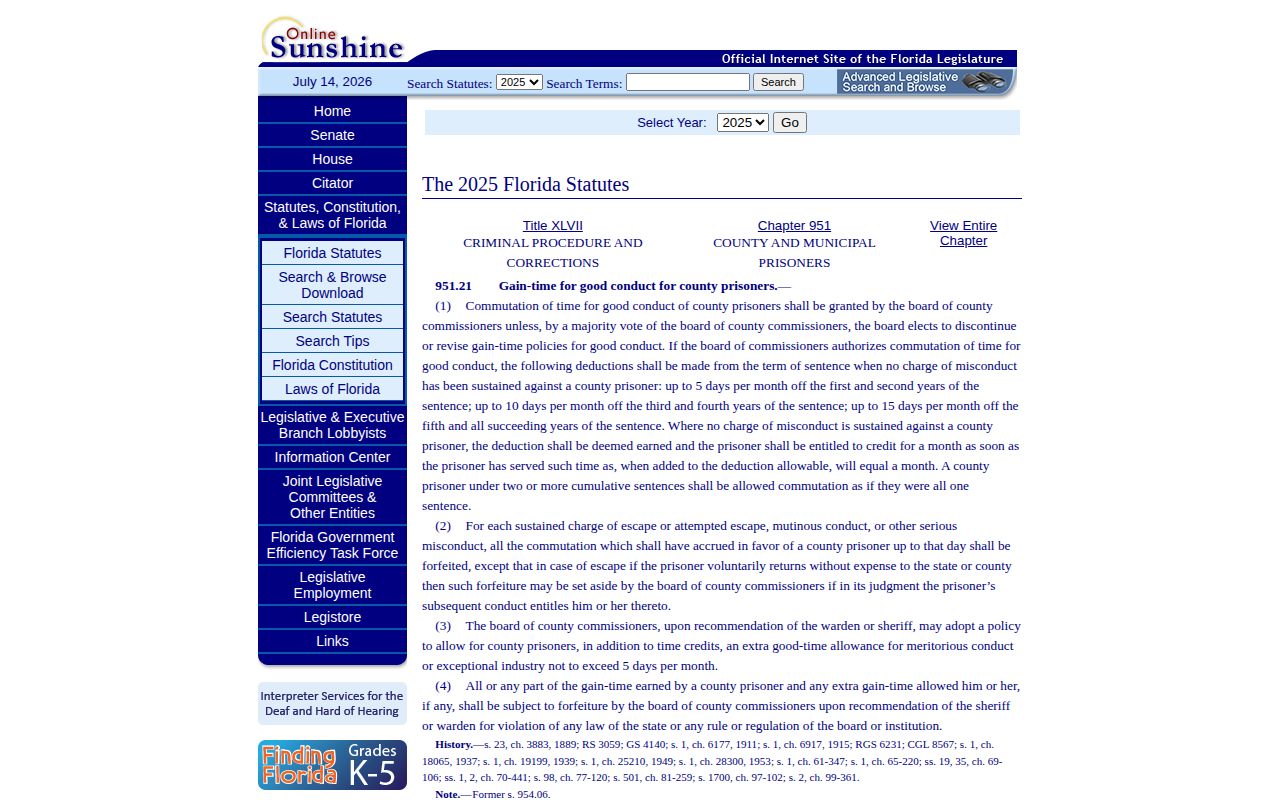
The county statute confirms why BSO sentence estimates must remain separate from state-prison gain-time calculations.
Broward Release Date Changes
A projected date changes when the facts used in the calculation change. Public records can lag a new order or review. Never revise an official date through personal arithmetic. Preserve the displayed value and access date, compare the judgment and sentence, then ask the responsible records or classification office to review the discrepancy.
| Change | Possible effect | Where to verify |
|---|---|---|
| Gain-time award or restoration | May move an FDC tentative date earlier within legal limits | FDC classification and sentence record |
| Forfeiture or discipline | May move the projected date later | FDC or jail records |
| Jail credit or corrected sentence | Can change the computation in either direction | Judgment, sentence, and agency calculation |
| Detainer or warrant | May prevent community release even when one custody term ends | Court, warrant, and receiving-agency records |
| New court order or sentence | Can replace the facts behind the prior date | Broward Clerk and sentencing court |
| Parole or conditional release action | Can change custody or add supervision | FCOR order and FDC status |
FDC publishes release-data and classification contacts for questions about the exact field. Supply the DC number and the record label. Avoid sending unrelated sensitive data. A county-jail question should go to BSO records or the sentencing court instead.
Confirm Broward Actual Release
When the projected date arrives, recheck the correct custody source. Keep the access date with every result. For state prison, look for the released detail with Release Date and Date Out-Custody. Then check supervision separately. For a Broward jail case, search BSO’s calendar-date release log and read the exact reason. A transfer closes BSO custody but continues confinement elsewhere.
VINELink can provide a custody-change alert while a matching record exists, but it is not a certified historical release record. Official agency records remain the confirmation source. If the web result is absent or inconsistent, request the release history and compare it with the latest court order. A release estimate becomes historical fact only when the responsible custodian records the completed event.
Note: Confirm the actual event after the date passes; do not treat an unchanged or expired projection as proof that the person left custody.