
Florida Corrections Release Paths
Florida Department of Corrections is a statewide prison system. A person sentenced in Broward County can leave BSO through a transfer and enter an FDC institution elsewhere in Florida. That BSO transfer is not a community release. Once state custody begins, the FDC record supplies continuity across institutions, movements, release planning, actual out-custody events, and later state supervision.
FDC divides public records by population. The inmate-population search concerns current state prisoners. The Inmate Release Information Search covers people already released or scheduled for release. The Supervised Population Search covers probation, community control, and post-prison supervision. A fourth search covers absconders and fugitives. These categories should not be merged. A released prison record may coexist with an active supervision record.
Confirm Florida Corrections Release
Begin at the FDC Corrections Offender Network menu. Choose Inmate Release Information Search for a completed or scheduled state release. A DC number is the cleanest query. Name search accepts last and first name, with an alias option. Confirm any match through DC number, birth date, photograph, physical details, offenses, sentence information, and county of commitment.
The detail labels carry distinct meanings. A current prisoner may have a Current Release Date or tentative date while incarceration history still says currently incarcerated. That is a projection. A completed record uses Release Date and can show a matching Date Out-Custody in the last incarceration-history row. Record the label exactly rather than calling every future date final.
- Choose the FDC release search, not the county jail search.
- Enter the DC number, or search by exact name and aliases.
- Confirm identity with birth date, photograph, offenses, and Broward county-of-commitment data.
- Read Release Date, release type, and the final Date Out-Custody together.
- Run the Supervised Population Search to check whether a duty remains after prison.
Note: An actual out-custody date confirms the state prison event, but it does not rule out later custody by another authority.
Florida Release Record Fields
The state detail can contain more than a single date. Available fields vary with the person and record type, so a blank field should not be filled by assumption. FDC may show aliases, a photograph, physical descriptors, current status or location, offense and sentence dates, county of commitment, release type, and supervision data.
| FDC field | How to read it |
|---|---|
| DC number | State identifier used to match records and requests |
| County of commitment | Sentencing connection, not current placement location |
| Current or tentative release date | Future estimate subject to change |
| Release Date | Reported state custody exit for the completed episode |
| Date Out-Custody | Movement-history confirmation of the prison exit |
| Release type | Agency label describing the exit |
| Supervision office or status | Possible continuing community obligation |
FDC says release data is updated nightly. The inmate population is fully refreshed weekly, with release dates and location changes updated nightly. Supervision records have their own cadence. Those schedules do not guarantee that a new court order will appear at once.
Florida Release Identity Checks
A name-only match is weak in a statewide system. Use the DC number whenever it is available. If a name search is necessary, compare aliases, birth date, photograph, race and sex, physical descriptors, offense history, sentence dates, and Broward as county of commitment. No single descriptive field should carry the whole match. A photograph can help distinguish two records, but it does not establish present custody or discharge.
The county-of-commitment field deserves special care. It shows the county tied to the sentence, not the institution where the person was held and not the county where the person now lives. A Broward commitment may lead to placement anywhere in the FDC system. Movement history and current location answer the custody-location question. The release search answers whether the state episode ended.
When the same person has several incarceration periods, read the dates as separate episodes. Match the Release Date to the correct admission and final Date Out-Custody. Then examine later records for a new sentence, return, or supervision period. FDC history is cumulative, so an old release does not prove that no later custody event exists. Preserve the DC number throughout the comparison.
Florida Release Transfer Checks
A Broward jail log may be the first record in a state custody chain. If BSO reports transfer to another jurisdiction, compare its timestamp with the FDC admission history. Close timing and matching identifiers can document the handoff, but the two entries retain separate agency meanings. The county event ends BSO custody. The state entry begins or continues FDC custody.
Later movement among FDC institutions is not a new community release. Search the current population and movement fields before treating a location change as discharge. When the final state release occurs, move to the dedicated release detail and then the supervision search. This sequence is especially important for a Broward sentence because the person may never be housed in a Broward-based state institution.
Florida Corrections Date Changes
Florida law calls the gain-time projection a tentative release date. Under Florida Statute section 944.275, FDC starts from the maximum sentence expiration date, applies lawful credit and gain-time, and adjusts for forfeiture, restoration, added sentences, and legal orders. For covered modern offenses, ordinary gain-time generally cannot move release ahead of the point at which eighty-five percent of the imposed sentence has been served.
That framework is not a quick calculator. Offense date, mandatory minimums, sentence structure, jail credit, discipline, review, and new court action can change the displayed date. Some records say “TO BE SET” while review remains pending. A life sentence does not become a numeric date through simple gain-time arithmetic. Use the FDC field as labeled and seek classification or court records when a binding computation is needed.
- Tentative release date
- A projected state prison exit after applicable credit and gain-time.
- Actual release date
- The date FDC reports the completed custody event.
- Gain-time
- A lawful sentence deduction that may be awarded, withheld, lost, restored, or recalculated.
- Discharge
- Completion of the stated custody or supervision obligation, which is distinct from a transfer.
Florida Corrections Release Records
If public search fields do not settle a Broward state release, request the record from FDC. The FDC public-records page routes requests to the Public Records Center and lists help at (850) 717-9774. Give the DC number and ask narrowly for release or discharge history, admission and out-custody movement records, release-date calculation history when needed, and the official photograph if it is part of the public record.
Release-data questions can go to (850) 488-9167 or dc.release@fdc.myflorida.com. Classification and current-data questions use (850) 488-9859. A request may lead to an estimate and review under Florida public-record law and corrections confidentiality rules. Do not ask FDC for a Broward county-jail bond sheet. BSO created that record, while FDC created the state-prison history.
Release information: (850) 488-9167
Public-record assistance: (850) 717-9774
Classification/current data: (850) 488-9859
dc.release@fdc.myflorida.com
The Broward County release record search explains the county side when a state transfer began at a BSO jail. Preserve both timestamps to show the handoff.
Florida Release Versus Supervision
An FDC prison release does not always end state correctional control. After locating the actual Release Date, search the supervised population. An active result can list the supervision type, start and termination dates, office, and status. Active means community supervision is in progress. Active Suspense can mean the person is unavailable for direct supervision while an officer monitors later events. Absconder is a separate status tied to unknown whereabouts and a violation warrant.
Florida Commission on Offender Review handles parole and specified conditional-release decisions, while FDC Community Corrections performs much field supervision. Modern Florida parole is limited because parole was effectively abolished for most offenses committed on or after October 1, 1983. Probation is imposed by a court. Conditional release is another statutory post-prison form. The release detail and supervision detail answer different questions.
| Search | Population | Result meaning |
|---|---|---|
| Inmate Population | Current state prisoners | Still in FDC prison custody |
| Inmate Release Information | Released or scheduled cases | Past release or future state date |
| Supervised Population | Community supervision | Out of prison with an active or past supervision record |
| Absconder/Fugitive | Specified wanted status | Not a synonym for release or discharge |
Florida Corrections Search Screens
The official FDC Inmate Release Information Search shows the released-first query route used for Broward state cases.
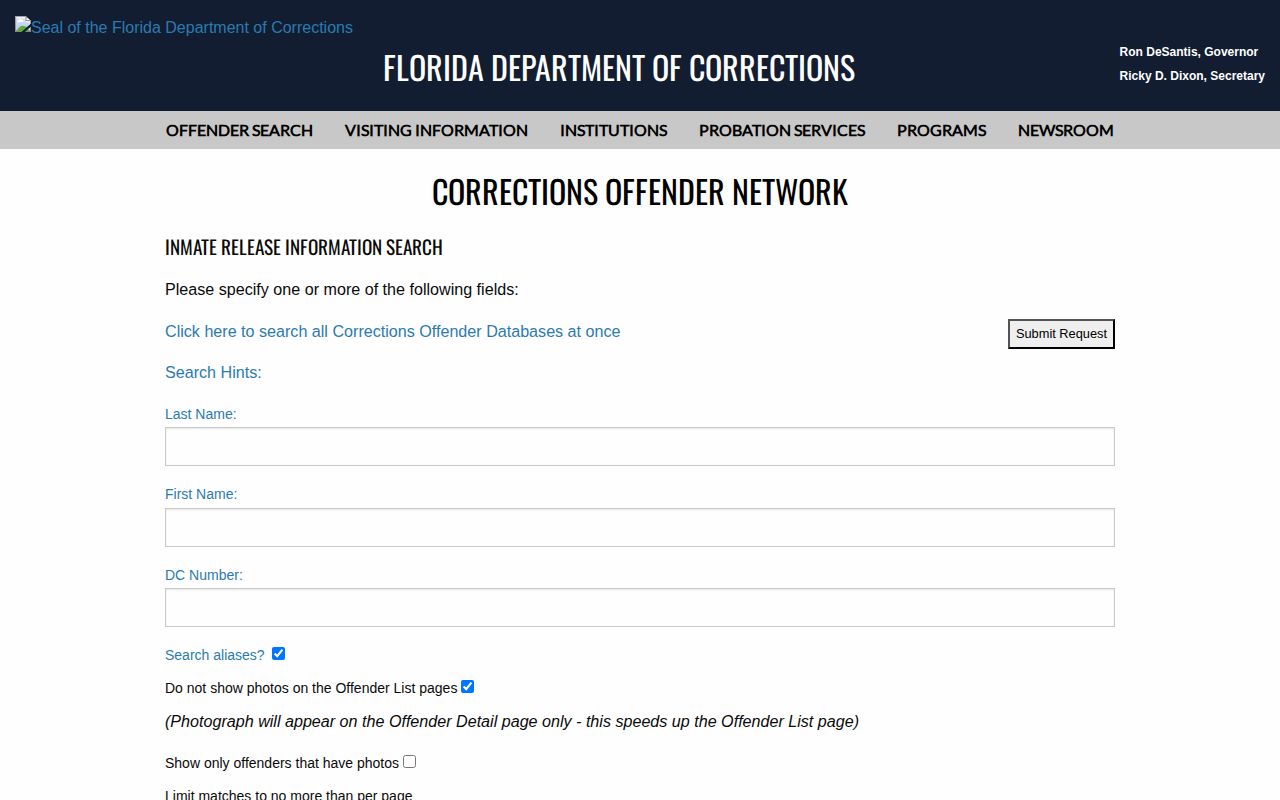
The form supports the DC-number and name checks that lead to the detailed release and out-custody history.
The FDC facility directory also identifies state institutions and Broward-area community release centers.
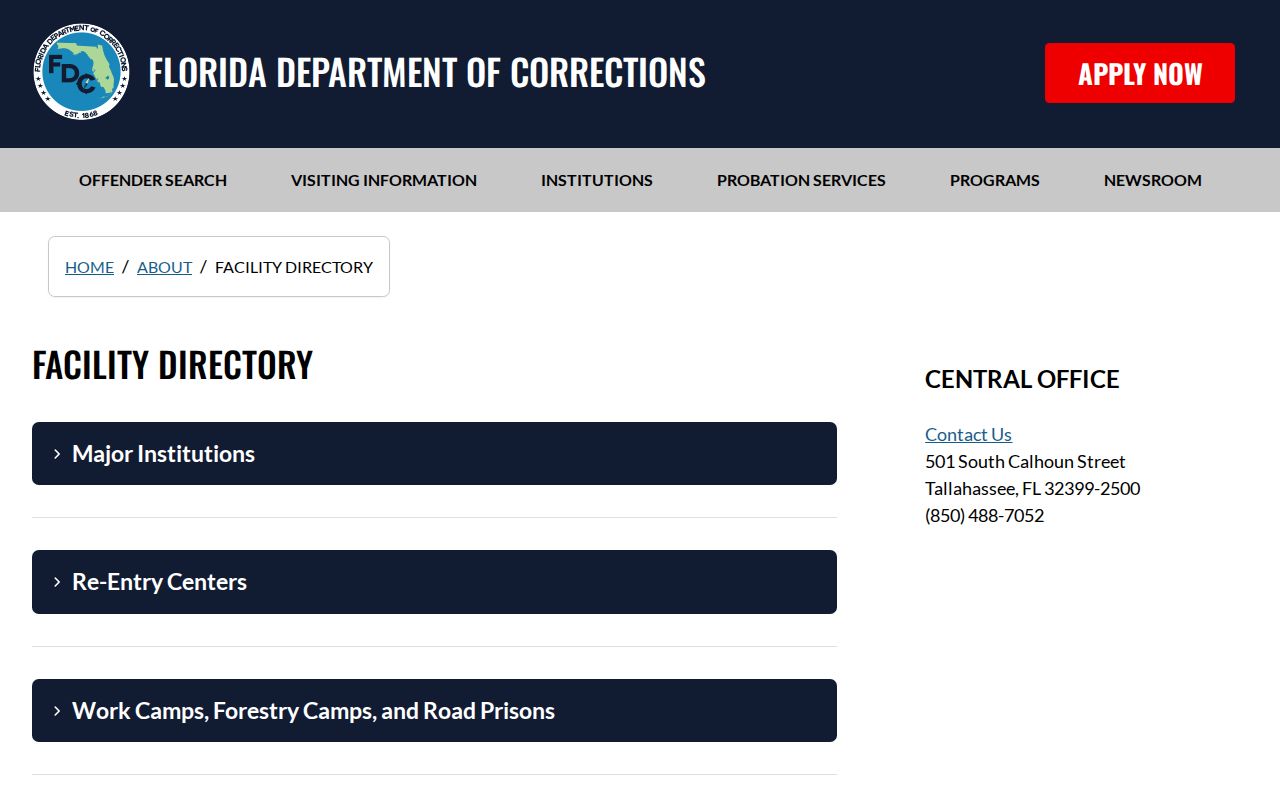
The directory is a location source. Final discharge still requires the release detail and Date Out-Custody fields.