
Broward County Release Records
A Broward County release record documents an operational event: a person left the custody of the Broward Sheriff's Office, the Florida Department of Corrections, or another named agency. It does not by itself settle the court case. BSO runs one county jail system with four housing facilities, and every county entry and exit passes through Main Jail Central Intake. Once release processing is complete, a person usually drops from the current Arrest Search. The date-selected BSO Inmate Release Log then becomes the primary county source.
The reason field controls what the event means. A bond, court-ordered pretrial release, time-served release, dismissal, or sentence expiration may send a person into the community. An entry such as “XFER TO OTHER JURIS” means BSO custody ended but another custodian may have taken over. State prison, federal detention, and immigration custody have separate records. Court disposition and post-release supervision are separate again. Reliable review keeps these records in sequence rather than treating every exit as freedom.
- Release
- The end of one agency's physical custody episode.
- Discharge
- The end of a sentence or supervision obligation, as shown by the responsible authority.
- Time served
- A sentence satisfied by time already spent in custody.
- Detainer
- A request or legal basis for another authority to take or keep custody.
Broward County Release Paths
BSO's daily record preserves the agency's exact release reason. That label should be read before the word “released” is used. The court docket then explains the legal order, charge status, and any later event. A bond ends jail custody while the case continues. A transfer ends the BSO episode but may start state, federal, county, or immigration custody. The common paths require different follow-up checks.
- Surety or cash bond
- Physical release while the case remains pending; verify the Broward Clerk docket and bond order.
- Pretrial release or monitoring
- Community release subject to court conditions; read the current order.
- Time served or sentence expired
- The recorded jail sentence may be complete; check other cases and holds.
- Dismissed, no-file, or acquitted
- A court or prosecutor ended the charge; obtain the disposition.
- Transfer
- Custody changed hands; follow FDC, another county, BOP, USMS, or ICE.
- Parole, probation, or conditional release
- Custody ended while supervision may continue; check FDC, FCOR, or the court.
A sealed, expunged, juvenile, or otherwise restricted record may not appear in a public search. A missing result does not prove that no custody event occurred. The lawful restriction should be respected, and any permitted request must go to the record custodian.
Inside Broward Release Records
Broward's daily release log is unusually detailed. Its public card and structured record can connect the release to the exact booking, arresting agency, charges, and court identifier. The strongest match uses the JMS number, birth date, admission and release times, arrest agency, and case or warrant number. Name alone is weak because aliases and shared names can produce false matches. The record is informational and may be corrected, so certified proof comes from BSO and the Clerk.
| Field | What it shows |
|---|---|
| Name, birth data, race, and sex | Identity details used to distinguish similar names |
| JMS number and BCCN | BSO identifiers for matching the custody episode |
| Admitted and arrested date/time | When the booking episode began |
| Released date/time | The completed BSO system exit |
| Release reason | Bond, pretrial release, transfer, or another agency-coded basis |
| Arresting agency and officer | The agency tied to the arrest, which may differ from BSO |
| Charge and warrant/case data | Descriptions, statutes, bond data, and the bridge to the court docket |
The release-log response did not contain a booking-photo field. A photograph may remain in the BSO arrest record or be available through a public-record request, but it should not be promised beside a daily release. Charge text also records an allegation or case history, not proof of guilt or present custody.
Request Broward Release Records
Use BSO's public-record request channel for a booking/release sheet, movement or release record, and any releasable booking photograph. A narrow request reduces search time and possible special-service charges. BSO handles requests in queue order and warns that duplicate submissions can slow the process. Electronic delivery and a cost estimate may be requested before chargeable work begins.
- Identify the person by full name and JMS or arrest number. Add birth date only when needed to distinguish identities.
- Give the approximate arrest, admission, and release dates plus the last known BSO facility.
- Name each document sought, such as the booking/release sheet, recorded release timestamp and reason, or separately maintained booking photo.
- Ask for electronic copies and an estimate before work that will create a charge.
- Request the dispositive order or a certified docket from the Broward Clerk when the legal result must also be proved.
P.O. Box 9507
Fort Lauderdale, FL 33310
(954) 831-8700
Monday through Thursday, 8:30 a.m. to 4 p.m.
Florida law does not require a person to state a purpose for an ordinary public-record request. However, exemptions can protect juvenile, medical, victim, sealed, expunged, investigative, or protected-address material. When only part is exempt, the custodian may redact that portion and release the rest.
Broward Release Record Laws
Florida Statutes section 119.07 governs executive-agency inspection and copying. It requires prompt acknowledgment and a good-faith response. Default charges may reach 15 cents for a one-sided page, 20 cents for a two-sided page, and $1 for a certified copy unless another law applies. Extensive clerical or technology work can support a reasonable special-service charge.
Court files follow Florida Rule of General Practice and Judicial Administration 2.420 rather than the executive-agency rule alone. Sealing and expunction also change public visibility. An FDLE Certificate of Eligibility is only the first step and does not itself seal a Broward case. The court must grant relief, and statutory agencies may retain specified access. Preserve needed certified records before a granted order is implemented.
Where Broward Releases Process
Every BSO system entry and release is processed through Main Jail Central Intake, even when the person was housed at Conte, North Broward, or Paul Rein. That is why the public source is one systemwide date log rather than four facility feeds. BSO does not promise a fixed gate time. Eligible release processing can vary with simultaneous intake volume and the availability of state and national database information. A court order or posted bond may start the process, but the completed release timestamp is the stronger proof that BSO custody ended.
Broward Release System Scale
BSO reported that its Department of Detention processes about 40,000 people each year and operates the sole county jail system. “People processed” is the correct measure. It is not a count of unique releases because one person may have more than one booking episode, and intake work is included. The figure explains why current roster data and release records can change during a busy processing period.
Broward Release Record Expunction
The Broward State Attorney's sealing and expunction program provides local forms, phone help at (954) 831-6955, and free community workshops held every few months. The workshop is practical help, not an order removing a record. FDLE eligibility and the judicial process still control, and the court may deny relief even after FDLE issues a certificate. The Clerk also identifies copying and certification charges plus a statutory processing fee after approval.
Sealing restricts general public access while the record remains. Expunction generally requires agencies to destroy or remove the record from ordinary public access, subject to statutory exceptions. Neither process should be inferred from a blank web search. The signed court order and agency implementation provide the reliable answer.
Find Released Broward County Inmates
Start with the agency that last held the person. Main Jail, Conte, North Broward, and Paul Rein all use the BSO path. A Florida prison or community release center uses FDC. Federal and immigration custody require BOP, the federal docket, USMS records, or ICE. The identifier also changes by system: JMS for BSO, DC for FDC, register number for BOP, A-number for ICE, and case number for a court.
- Check BSO Arrest Search once. A current-location result means BSO still reports custody. Save the JMS number and exact spelling.
- Search the BSO Inmate Release Log by expected calendar date, then adjacent dates if needed. Match several identity fields.
- Read the exact release reason. Treat a transfer as continued custody until the receiving authority confirms otherwise.
- Open the Broward Clerk case and compare the case number, charges, arrest date, orders, sentence, and later docket events.
- Follow a transfer through FDC, another county, BOP or the federal docket, or ICE ODLS as the record indicates.
- Check FDC supervision or the applicable court and request official records when online sources do not settle the timeline.
The Broward Jail Releases: 24 Hours method explains how to combine the daily log's exact timestamps for a recent window. For one named person, the full chain remains essential because a same-day list cannot show every later transfer or court event.
FDC Broward Release Search
Florida provides distinct searches for distinct populations. The Inmate Release Information Search is the released-first route for a completed state-prison episode. Inmate Population Information concerns people in state prison and can show a future date. Supervised Population Information concerns people in the community under FDC supervision. Absconder/Fugitive Information is a separate wanted-status source. A Broward bond release usually will not appear as an FDC release unless the person also has an FDC history.
| Search field | Use | Verification |
|---|---|---|
| DC number | Best direct identifier | Match the full number |
| Last and first name | Find a record when the DC number is unknown | Compare birth date, photo, and county |
| Alias option | Find another recorded name | Confirm against court and identity details |
| County of commitment | Connect a state sentence to Broward | Do not treat it as current location |
| Release Date and Date Out-Custody | Confirm a completed FDC exit | Check supervision separately |
The FDC Corrections Offender Network menu shows these population choices side by side.
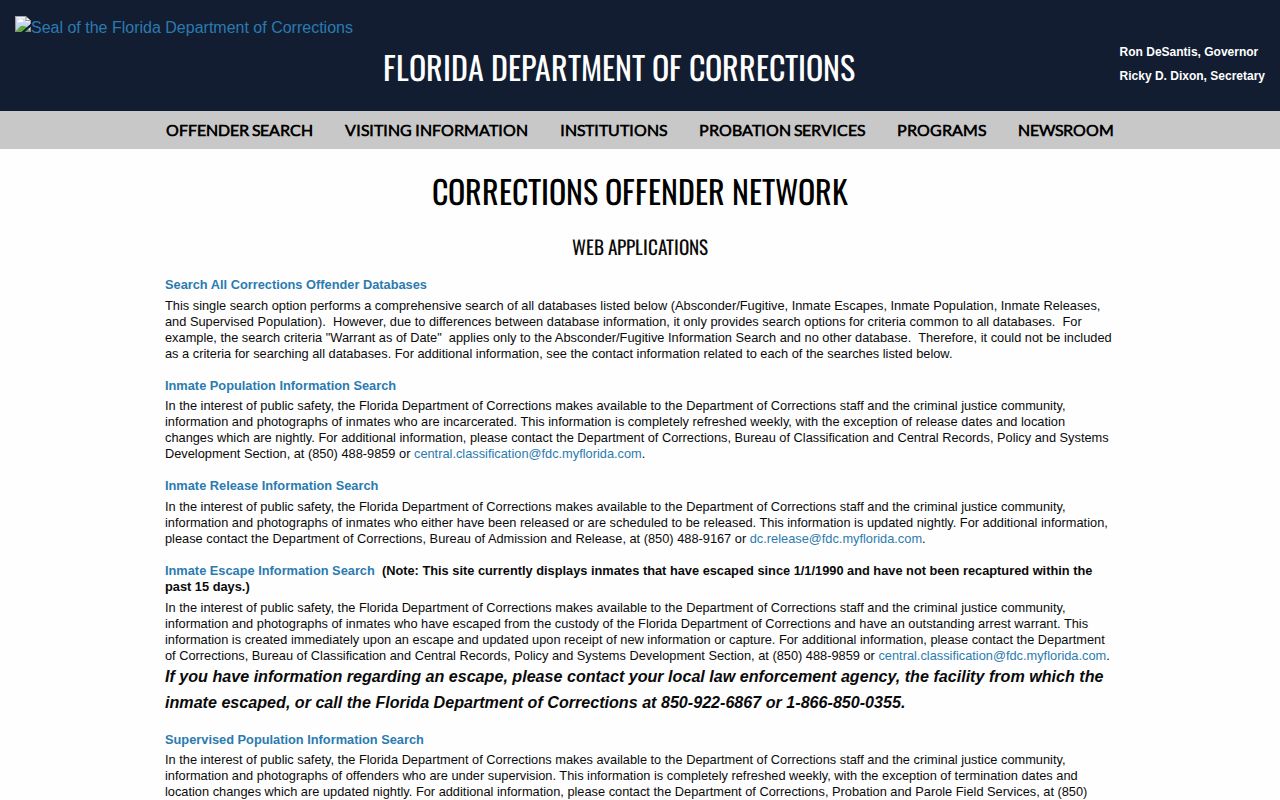
The separate labels prevent a projected state-prison date from being mistaken for an actual Broward County release.
Broward County Daily Release Log
BSO's official product selects one calendar date. It is not labeled as a rolling 24-hour or 72-hour feed. To review roughly one day, retrieve today and the preceding date and filter by the displayed release times. To review about three days, use three or four adjacent dates, depending on the start and end times. The separate Booking Blotter covers arrests processed in a two-day range and warns of a lag; it does not prove that anyone was released.
The working BSO release application should be saved because the older branded host returned an error during research.
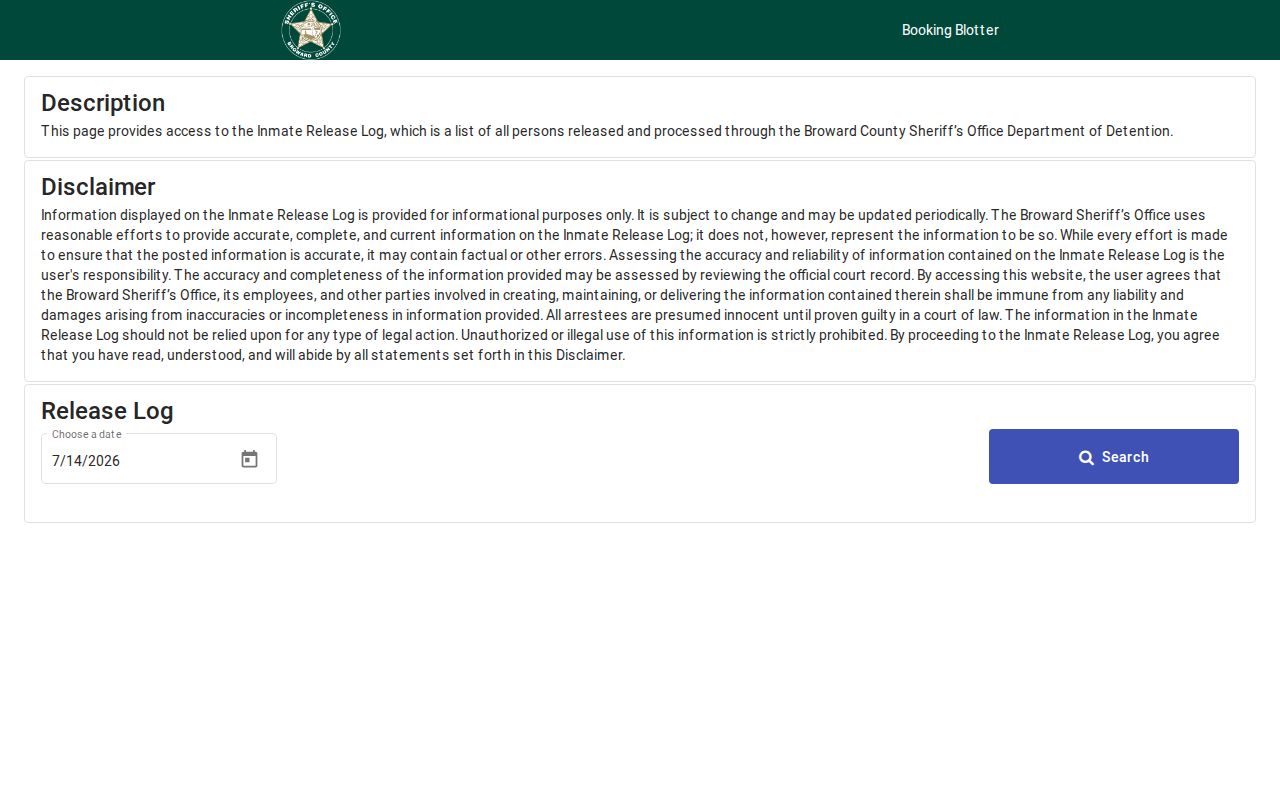
The date selector and exact timestamps support a defensible time window while preserving BSO's own release reason.
BSO says information may change and be updated periodically. It publishes no guaranteed minute cadence or online retention term. Recheck a very recent event. For an urgent or older record, call detention information at (954) 831-5900 and use the Public Records Unit for the maintained document.
Broward County Release Supervision
Release from custody does not always end correctional control. FDC Community Corrections supervises felony probation, community control, and state post-prison release. BSO Community Programs handles county-level functions that include misdemeanor probation, while U.S. Probation handles federal supervision. The sentence and release type select the agency, not the person's Broward address.
For state supervision, search FDC's Supervised Population Information by DC number or name. Read current history before prior history, then use the office listed on the record. “Active” means current community supervision. “Active Suspense” can mean the person is temporarily unavailable for direct supervision, including while held elsewhere. “Absconder” means FDC reports that whereabouts are unknown and a violation warrant has issued. It is not another word for released. More detail appears on the Broward County Probation & Parole page.
Broward Release Reentry Help
BSO's Reentry Division operates a Broward Reentry Portal for people returning from Florida prisons and a voluntary Jail Reentry Desk at the Main Jail exit. The desk assesses immediate needs, makes referrals, and can provide bus passes. BSO says follow-up communication occurs within 24 hours after discharge. This local service can help with the transition, but it is not a custody-status source. Release still must be verified in the BSO or FDC record.
Broward Release Alerts and Locators
Broward VINE covers offenders in BSO county jails and can send notice of release, transfer, work-release approval, escape, or death. It is prospective. Register while a matching custody record exists, keep the confirmation PIN, and still verify an alert against BSO's release log or the responsible agency. Florida VINELink does not replace BOP or ICE searches, and a missed notice does not establish continued custody.
For a federal sentence, the BOP Inmate Locator can retain records from 1982 forward and display a release date with “Released” or “Not in BOP Custody.” Those labels only address BOP. Another authority may hold the person, and federal supervision can continue. Federal pretrial orders come from the court, and some USMS custody never produces a public BOP locator record.
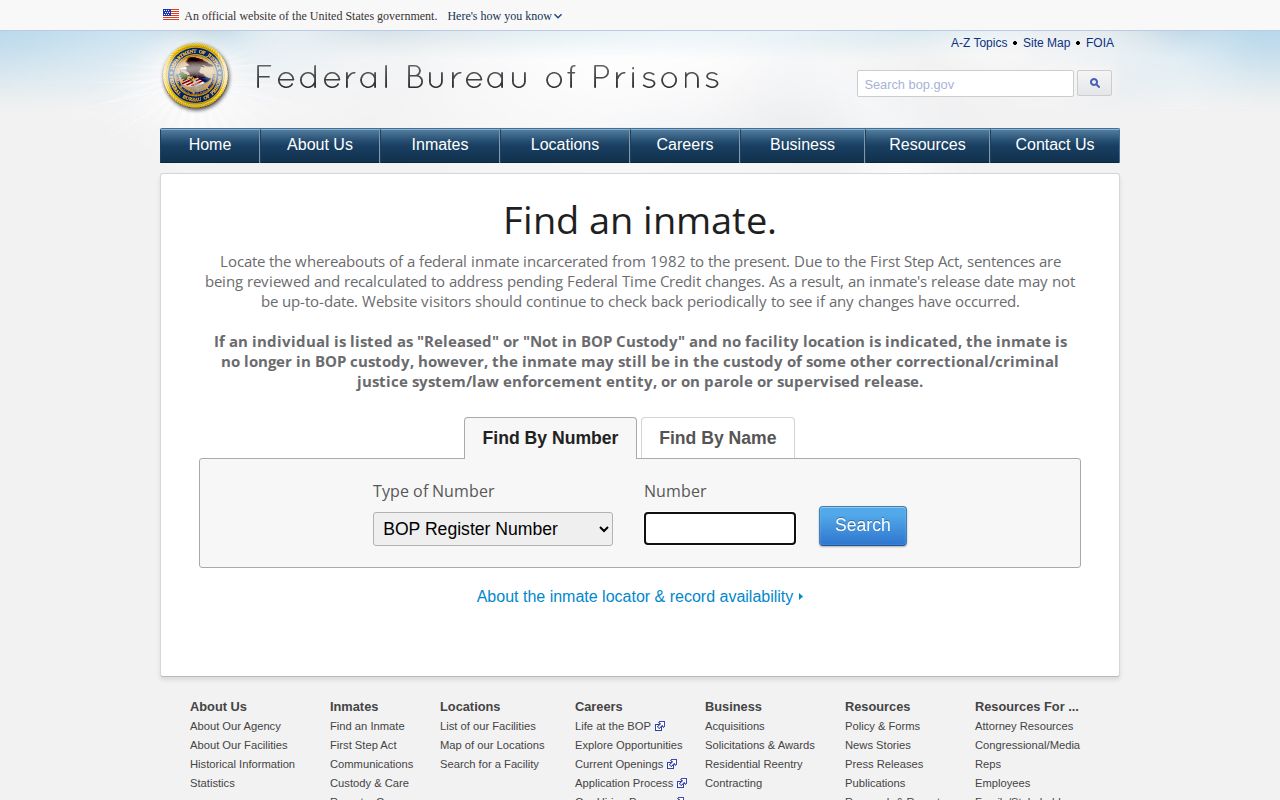
The BOP fields are useful only after the record is matched by register number or several identity details.
Broward Release Docket Match
The Broward Clerk public case search requires both first and last name for a party search, and public results stop at 200. A known criminal case number is more precise: enter its 13 characters without spaces or dashes. The BSO log's case or warrant identifier can bridge the custody event to the disposition, bond order, sentence, probation order, later remand, or termination order.
The web docket is not the official court record, and some images or cases are restricted. A “case closed” entry is not a release timestamp, just as a BSO release is not proof that a case closed. For formal use, ask the Clerk for the certified disposition and relevant order.
Broward ICE Release Transfers
Broward Transitional Center creates a local second-custody problem. A BSO transfer tied to an immigration hold may lead to ICE detention in Pompano Beach rather than the community. ICE's Online Detainee Locator accepts an A-number and country of birth or biographical details. Its public scope includes current detainees and people released from ICE custody during the prior 60 days.
A missing older ICE result is inconclusive. Spelling, A-number formatting, transfer, release, or removal can affect the result, and an ICE “release” does not by itself explain the final immigration outcome. Contact the responsible ICE Enforcement and Removal Operations office or request the agency record when the locator does not settle the status.
Broward Release Search Differences
Each public system proves only its own part of the timeline. A live roster answers whether one custodian currently reports confinement. A release record answers when that custodian's episode ended. Court and supervision records answer different questions. The source must match both the institution and the date.
| Source | Best use | What it cannot prove alone |
|---|---|---|
| BSO Arrest Search | Current county-jail location and booking identifiers | Why an absent person left custody |
| BSO Inmate Release Log | Exact county exit time and reason | Final court outcome or freedom after transfer |
| Broward Clerk | Orders, disposition, sentence, and later case events | The exact BSO processing timestamp |
| FDC release search | Completed state-prison release and date out-custody | Whether supervision or another custody episode exists |
| FDC population search | Current state custody and projected date | A completed release |
| BOP or ICE locator | Federal or immigration system status within published scope | Status under every other authority |
Note: A photograph can help confirm identity, but it does not prove present custody, release, guilt, or the result of a charge.
Broward County Release Facilities
The facility name selects the correct release path. Broward County Main Jail, Joseph V. Conte Facility, North Broward Bureau, and Paul Rein Detention Facility are BSO housing locations that share Central Intake and the daily release log. Broward Transitional Center is an ICE facility. Hollywood and Turning Point community release centers remain within FDC custody until final discharge. FDC's statewide page follows a person transferred into state prison, while Federal Detention Center Miami and the nationwide BOP system cover a separate sovereign.
Broward County Main Jail / Main Jail Bureau: BSO Central Intake and daily release log.
Joseph V. Conte Facility: shared BSO county-jail release process.
North Broward Bureau: shared BSO process with medical privacy preserved.
Paul Rein Detention Facility: shared BSO date log and release reason.
Broward Transitional Center: ICE locator and ERO confirmation.
Florida Department of Corrections statewide institutions: FDC population, release, and supervision records.
Hollywood Community Release Center (Female): FDC actual release and out-custody history.
Turning Point Community Release Center (Male): FDC actual release and supervision check.
Federal Detention Center Miami and the nationwide Bureau of Prisons system: federal docket, USMS records, and BOP locator.
Housing location is not release status. North Broward placement must not be used to infer a diagnosis, and movement between BSO facilities is not a system release.